Rosie The Riveter Tools Of The Mind

Certainly, one of the more readily recognizable icons of labor is 'Rosie the Riveter,' the indefatigable World War II-era woman who rolled up her sleeves, flexed her arm muscles and said, 'We Can Do It!' But, this isn't the original Rosie. In 1942, as World War II raged in Europe and the Pacific and the song 'Rosie the Riveter' filled radio waves across the home front, manufacturing giant Westinghouse commissioned artist J. Howard Miller to make a series of posters to promote the war effort.
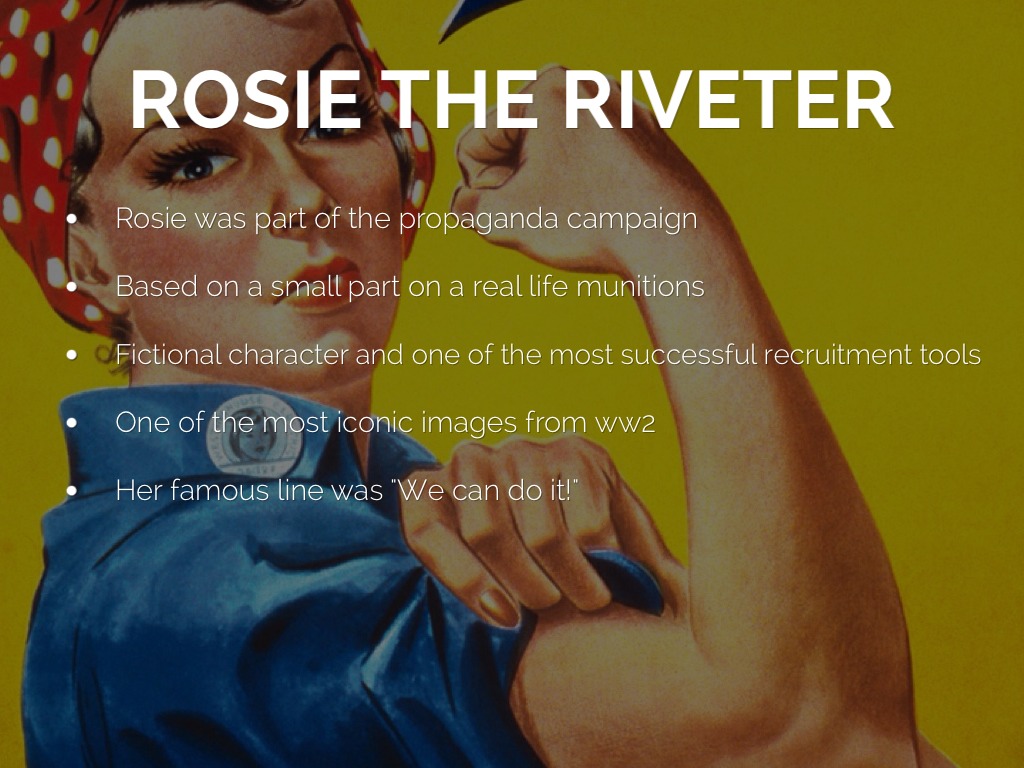
One such poster featured the image of a woman with her hair wrapped up in a red polka-dot scarf, rolling up her sleeve and flexing her bicep. At the top of the poster, the words ‘We Can Do It!' Are printed in a blue caption bubble. To many people, this image is 'the' Rosie the Riveter. But it was never the intention to make this image 'Rosie,' nor did many Americans think of her as 'Rosie.'
Rosie The Riveter Remembers. In my mind San Diego sounded closer to Washington than. So gradually I educated myself about the various tools and their uses. She is a contributing writer for Forbes, Women. The 1943 “Rosie the Riveter. Where the workplace is designed with women in mind and where we. Nfpa 12 Standard On Carbon Dioxide Extinguishing Systems 2011 Edition on this page.
The connection of Miller's image and 'Rosie' is a recent phenomenon. The 'Rosie' image popular during the war was created by illustrator Norman Rockwell (who had most certainly heard the 'Rosie the Riveter' song) for the cover of the Saturday Evening Post on May 29, 1943 — the Memorial Day issue.
The image depicts a muscular woman wearing overalls, goggles and pins of honor on her lapel. She sports a leather wrist band and rolled-up sleeves. Free Download Rejoice The Emotions Rar Programs For Mac here. She sits with a riveting tool in her lap, eating a sandwich, and 'Rosie' is inscribed on her lunch pail.
And, she's stepping on a copy of Adolph Hitler's book 'Mein Kampf.' The magazine cover exemplified the American can-do spirit and illustrated the notion of women working in previously male-dominated manufacturing jobs, an ever-growing reality, to help the United States fight the war while the men fought over seas. The cover was an enormous success and soon stories about real life 'Rosies' began appearing in newspapers across the country. The government took advantage of the popularity of Rosie the Riveter and embarked on a recruiting campaign of the same name. The campaign brought millions of women out of the home and into the workforce. To this day, Rosie the Riveter is still considered the most successful government advertising campaign in history.